Hiển thị các bài đăng có nhãn edu-sig. Hiển thị tất cả bài đăng

Thứ Sáu, 12 tháng 6, 2015

Nicholas Tollervey and Python in Education


As many of you know, the use of Python in education has grown tremendously in the past several years (see PSF Newsblog).  The Python community celebrates this trend, and continues to strengthen our connections to the world of education. PyCon’s first education summit at PyCon 2013, initiated by Naomi Cedar (who was recently elected to the PSF Board of Directors), has been followed globally by many Python conferences holding education tracks and getting involved with community teachers and education leaders.


Recently PyCon UK and EuroPython announced their upcoming education tracks.


After attending the Education Summit at PyCon2015 in Montreal, I was inspired to read Nicholas Tollervey’s wonderful booklet, Python in Education


(MAS reading and learning)


Here Tollervey summarizes and explains Python’s use in education, recounts the history of the Python programming language, provides a case study of the amazing Raspberry Pi, and describes the important role played by the Python community in the language’s popularity and ability to meet and adapt to users' needs. 


After reading his booklet, I had some questions for Nicholas: 


Q: What was your motivation for writing this book?


NT: during my 20s I was a senior secondary school teacher in the UK - I taught music to teenagers growing up in areas of great poverty and deprivation. As a result I’m passionate about teaching and learning - especially as a vehicle for emancipation. Unsurprisingly, I see programming and technical literacy as such vehicles. This is reinforced because I also have three school aged children.


Q: How long were you thinking about and/or writing the book? 


NT: I’ve been thinking about programming and Python in education for quite a number of years. Given all that’s happening regarding computing education in the UK at the moment, I’ve also had a lot of opportunity to discuss the subject with a large number of teachers and developers and develop my outlook as a result (a process that is ongoing). The first draft of the report only took a weekend to write - although I made time during the following weeks for tidying up and editing (re-reading with fresh eyes is such a useful thing to do).


Q: Did you have the book’s contents in mind or did you discover it via research? 


NT: The philosophical outlook was very much the result of the discussions mentioned in the previous point. I also spent a day at Raspberry Pi Towerschatting with Eben, Carrie Anne and Ben [Editor’s Note: Eben Upton, Carrie Anne Philbin, and Ben Nuttall of the Raspberry Pi Foundation; Carrie Anne was recently elected to the PSF Board of Directors]. 


The case study in the second section is the result. The rest of the book just wrote itself (as it were) and I, of course, was very careful to ensure I was reporting the correct information while referencing others.


Q: Can you tell us a bit about your background in Python in education?


NT: I was a senior teacher. I also have an MA in Philosophy of Education and a PGCE (Post Graduate Certificate in Education). For the last 4-5 years I’ve organised the PyconUK education track: last year we had 50 teachers and 90 kids turn up. This year will be bigger still. I also founded and help to run the London Python Code Dojo where developers come together to teach and learn from each other (see: http://ntoll.org/article/how-to-run-an-awesome-code-dojo for details of what a dojo is). I also collaborate with teachers on an ad hoc basis - for example, tomorrow I’m at a school in Nottinghamshire to help teach teachers to teach programming. This will be followed by some practical workshops helping a bunch of kids take their first steps as the tame programmer in the room along with all these hopefully newly enthused teachers. ;-)


Q: Anything else…? 


NT: YES! I always try to imagine who I’m writing for. In this case it was programmers who need an easy to remember source of arguments in favour of Python in education and teachers, students, parents and school board types (i.e. policy makers) who know nothing about computing but who need information in an easy to digest format. I wanted to write a kind of manifesto (but without explicitly calling it one because that has all sorts of connotations) that would expose all the amazing work and progress the Python community has made in the world of education. It’s all about helping people join the dots, make connections and collaborate. By the end of the book I want the reader to want to teach and learn Python. ;-)


An e-copy of Nicholas’s book can be obtained for free from O'Reilly. I highly recommend reading it, giving it to others as an introduction to this increasingly important topic, and getting involved in the education tracks at PyCons and in CS education activities in your communities.


I would love to hear from readers. Please send feedback, comments, or blog ideas to me at msushi@gnosis.cx.


Thứ Năm, 30 tháng 4, 2015

South African Brothers and Sisters for Python


Today’s post is a follow-up to a previous post about a PSF funded project by Hyperion Development in South Africa. 


The PSF has recently heard from Riaz Moola about his latest project–working with Brothers For All to deliver Python courses in 42 prisons–including eight female corrections facilities–in the Western Cape.


Brothers is run by an ex-con, Sihle Tshabalala, who taught himself to code online. When he got out of prison, he wanted to do something to slow the recidivism rate of South African ex-convicts. Not only does South Africa have the world’s eighth highest prison population, but the rate of re-offenders is over 80%. In addition, an extremely high unemployment rate of 25% adds to the hopelessness felt by those with prison records and without marketable skills.


Brothers began last September by opening a center in a Western Cape township area. There, ex-cons and at-risk youth come to learn coding skills, entrepreneurship, and marketable crafts.


According to Tshabalala,


“We chose coding because it leapfrogs over the need for more conventional, expensive and time consuming job skills training… Plus there currently is a high demand in the market for such skilled labour.”


They have recently been given approval by the provincial government to take the program into 42 prisons in the Western Cape. This way, prisoners can gain skills while incarcerated so that they are ready for employment immediately upon release. 


The ambitious scope of this program caused Brothers to partner up with Hyperion. While Brothers will focus on getting the programs into the prisons and more township areas, Hyperion will provide course content.


Hyperion’s main concerns at this point are logistical and for long-term sustainability. As Riaz told the PSF, there are many challenges specific to South Africa; for example, for four hours every day there is a power blackout, which obviously poses a problem for internet connectivity. In addition, South Africa has the highest data costs of any country in the world. Travel for tutors and volunteers is also very expensive. And then, of course, there’s the poverty and its inevitable expression in crime. Sadly, one of the project’s computer labs was recently burglarized, resulting in the loss of equipment. But Brothers also has support streams, so they are currently receiving donations to make up for the loss. In future, they plan to purchase laptops, which can be more easily secured.


Hyperion has been able to achieve a solid team of Python instructors. With the help of the PSF and other institutions, Hyperion is able to pay the travel and data costs for their volunteers. This has allowed them to be very selective; their instructors must pass tests of their technological and teamwork skills. Even so, Riaz tells us, they are never at a loss for instructor applicants.


The Cape Town team, led by Hyperion manager Sobane Motlomelo (a Master’s degree student at University of Cape Town), will be primarily responsible for handling the prison project. Sobane's team has recently accepted four new members, and Riaz is confident of their ability. This is good news for Riaz, who began Hyperion as an experiment when he was an undergraduate, then saw it spiral into something very large, to which he has been giving all his time. Currently he’d like to step back just a bit. Our congratulations to him on being offered a Google internship! 


More info on this remarkable program can be found at its twitter page and htxt.africa.


I would love to hear from readers. Please send feedback, comments, or blog ideas to me at msushi@gnosis.cx.


Thứ Năm, 16 tháng 4, 2015

My Dinner with Katie


Last week at PyCon, I had the pleasure of talking with Katie Cunningham at a dinner party hosted by O'Reilly. Katie is well-known in the Python community. The author of Python in 24 Hours, 2nd edition (Pearson 2013),  Accessibility Handbook (O'Reilly 2012), and a video series Python Guide for the Total Beginner LiveLessons (Pearson 2013), she has also given talks and presentations at a number of conferences. Last year the PSF honored her with its Community Service Award in recognition for her work in founding and providing the Young Coders tutorial (along with co-recipient Barbara Shaurette).


Imagine a room filled with pre-teens and teenagers eager to learn to code. Pretty daunting, huh? That’s the challenge Katie has taken on with Young Coders. This one-day tutorial covers basic Python by starting with simple concepts and then building up. Using Raspberry Pis, Katie says, helps to “demystify the computer,” and by the end of the day, students are doing fairly complex work with loops, and reading others' code. Last week at PyCon Montreal, 41 students attended one of the classes.

You can check out Katie and Barbara’s 2014 PyCon talk about Young Coders.


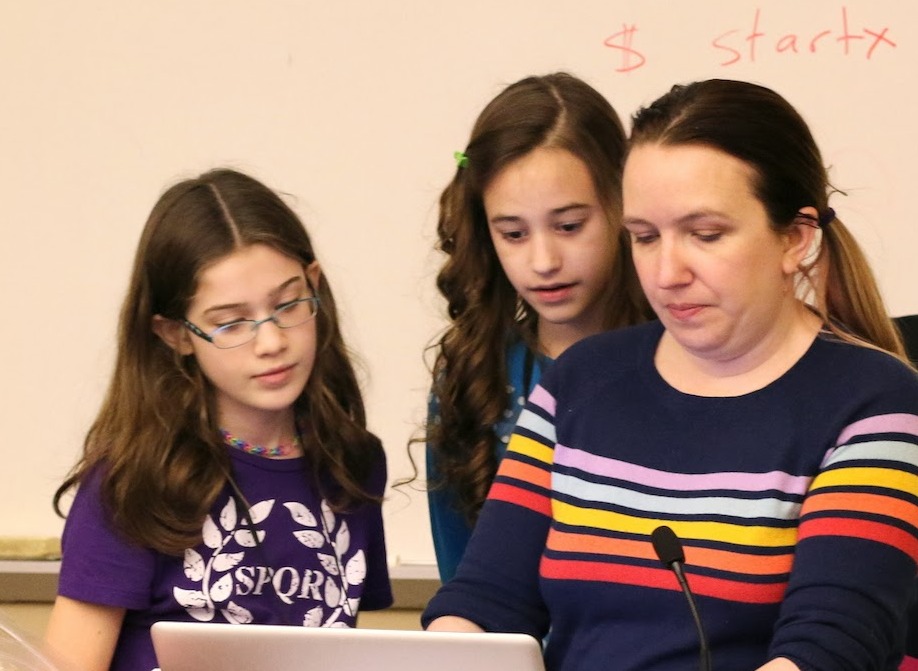
Katie teaching Young Coders


As we conversed about Python, teaching, and writing, I observed first-hand those qualities that make Katie an effective teacher—passion, clarity, perceptiveness, wit, and humor. With a degree in Psychology, she “stumbled into technology” and found that it paid well. “It’s hard to say ‘no’ to money when the alternative is to get an MA degree and make $40K,” she explained. But I believe that Katie is a natural teacher, so I’m not surprised that once in tech—she’s worked for NASA and Cox Media—she pioneered ways of making it more accessible to others and easier to learn. Her current professional position combines her technological prowess and her pedagogical talents as Senior Applications Developer and Director of Technology at Speak Agent, a provider of customized interactive content for language teachers. 


Some of Katie’s teaching philosophy and techniques come from her experience as a mother. She told me that her kids had access to their own computers at the age of three, in large part because she wanted them to stay away from her computer. The result is that her kids are very fluent—if you give them a computer, they can figure out immediately what to do with it. It’s not, according to Katie, that her seven year old daughter is so smart; rather she’s had four years of informal training. But of course many kids don’t have that advantage—they’ve grown up in homes where there was no computer, or maybe only one, but it was too precious to allow the kids to use it. Katie wants to be able to formalize the informal training—to teach kids such basic ideas as how to generally find something on the computer, or the differences between an email application, a web browser, and the internet (some kids, and even adults, confuse them). 


So Katie finds that using concrete metaphors and teaching basic vocabulary are extremely important in getting kids to understand coding. For example, Katie teaches the logic of and/or by reference to pet stores; in Virginia, in order to buy a fish, a person needs to be at least 18 years old, AND have money to pay for it, AND promise to put it in an aquarium and not into the river (apparently, this was a problem)—all of these conditions must be true. But when paying, you can use cash OR credit OR a data card OR a gift card. She says that her students respond well to these kinds of examples. Teaching this way is not only effective, but it “brings the humanity back into tech”—it shows that these are things that humans do, rather than abstract relations between a person and a machine. 


In the future, Katie would like to teach coding to younger children. Since the Young Coders track is restricted to ages 12 and older, Katie sees this as a real need. We have younger kids coming to PyCon, as more attendees bring their kids and want a class for them. But putting very young kids in a class with older learners doesn’t work well. Their needs and learning styles are quite different. For example, five year olds don’t have the physical control or dexterity to type or to sit still for long. Katie would like to develop a teaching track that is “more kinetic.” Basic concepts, like the logic of if/elif/else could be taught by having the kids get in one line IF their shirt is red, ELSE IF green, get in another; or ELSE, yet another.


I’m happy to report that these and other great ideas are going to be available in Katie’s next book, Kids Code (current working title). It will be an O'Reilly interactive book that has a dual purpose: 


[It] … not only teaches the student how to program, but teaches the mentor how to teach. Through carefully laid and interactive chapters, the student is guided not only through the basics of programming, but all the way up to game development and creating websites. At the same time, the mentor is coached in how to help their student solve problems, warned about where students often have trouble, and explains why lessons are structured in a certain way” (see LinkedIn).


The book sounds like a wonderful tool for teachers and learners (of all ages) and I’m looking forward to reading it. Thank you Katie, for sharing your expertise and insight with the rest of us. Your work is a huge part of what makes the Python community a living, growing, exciting, and powerful entity of awesomeness.


I would love to hear from readers. Please send feedback, comments, or blog ideas to me at msushi@gnosis.cx.



Popular Posts

Magix Vegas Pro 17.0.0.452 Free Download Magix Vegas Pro 17.0.0.452 Free Download includes all the necessary files to run perfectly on your ...