Hiển thị các bài đăng có nhãn conference. Hiển thị tất cả bài đăng

Thứ Năm, 24 tháng 5, 2018

PyCaribbean, Come for the Language, Stay for the Culture

PyCaribbean is more than Python, it is people, culture, and  spending  time together. Lead organizer Leonardo Jimenez wants attendees to feel like they are home when they are at PyCaribbean. “That sense of belonging and creating a bond helps the community members feel that they have a community that will support them and they can share their experience and knowledge with,” Jimenez explains.


After receiving an invite to speak at PyCaribbean 2017, which  I was unable to attend, I intentionally saved the date for 2018  . Santo Domingo, the capital of the Dominican Republic, hosted PyCaribbean this year.   Now, before we continue, let’s kick off this blog post the right way. Hit play, then continue reading.


Welcome to PyCaribbean 2018! Hosting some 280 Pythonistas from Puerto Rico, Colombia, Venezuela, Cuba, Bermuda, all across the Dominican Republic, and more the conference boasted 50 more attendees than 2017 when it was held in San Juan, Puerto Rico. PyCaribbean is one of the earliest Python conferences started in Latin America and has since iinspired other Latin American countries to host their own Python conferences.


“The community is getting bigger and stronger [over] time,” said Jimenez “[Community members] show more interest to learn new things, get more practice and experience.”


The PyCaribbean organizers scheduled a wide  ariety of talks that were aimed at all levels  in both English and Spanish. One of this year’s speakers, Ordanis Sanchez, gave a talk on getting started in Python. As noted by attendee Rebecca Conley, this was Ordains’ first conference talk in English!


Every conference I attend, I like to focus on a handful of take aways to share. One talk that I especially enjoyed was by Felipe Hoffa, a developer advocate from Google. Hoffa’s research concluded that not all text used in submitting an issue to a code repository will lead have the same closure rates. I learned that starting a ticket with the phrase, “I get the following...,” will have the highest probability of closure.


For me, the best part about this year has to be the founding of Pyladies Santo Domingo! Natacha De la Rosa and Samantha Valdez met at PyCaribbean, and they have a slick website and super CUTE logo!!!!! Swoon!!!



PyCaribbean is already making plans for next year. The possible locations sound amazing, but what doesn’t sound amazing in the Caribbean? The organizers are currently waiting on confirmation from the location before announcing. I assure you that when it is announced, it will not disappoint. Their hopes are to firstly have 400 attendees next year, secondly more participants from a variety of Caribbean countries, and lastly to create a board with different members of the Caribbean community. If you are interested, reach out to Jimenez <leonardo@pycaribbean.com.


Like with most conferences in the Python community, PyCaribbean is volunteer run. Thank you to the 40 volunteers who made PyCaribbean a success and who continue to foster community in their own cities in the Dominican Republic and beyond!


And that’s a wrap, or at least until next year’s PyCaribbean!


Thứ Ba, 22 tháng 12, 2015

Python-Cuba Workgroup


Today I’d like to report on some of the progress that has been made as a result of last years' controversy over an April 1st joke post about a (fictional) PyCon to be held in Cuba. As you may recall, the joke fell flat for many–nonetheless, the intent to instigate a real movement toward greater communication with Cuban Pythonistas, and perhaps to someday hold a conference on the island, was fulfilled beyond the authors' expectations! 


The first step occurred in May with the formation of a Python-Cuba Workgroup, which was recognized in June by the PSF board as an official workgroup with a charter. Since some group members already had contacts with Cuban programmers, the workgroup was able to begin a healthy collaboration. In addition, several Cuban Pythonistas made contact with us after the April 1st newsblog post. Discussion and analysis of issues, including internet access in Cuba, how to accommodate a multi-lingual group, governmental involvement and obstacles, etc., began in earnest over the summer. 


Thanks to the hard work of many, including Kirby Unger, David Mertz, Roberto Rosario, Steve Holden, Luciano Ramalho, Pablo Celayes in Argentina, Olemis Lang in Cuba, and dozens of other supporters and members, the group has recently gotten off the ground, and it looks like great things are about to happen!


Pablo Celayes deserves special mention for his efforts in involving his recently formed Python meet-up group in Cordoba, Argentina in the Python-Cuba effort (Cordoba, Argentina meet-up). Cuban developer, Alejandro Zamora Fonesca, is planning to visit Pablo and the rest of this group in Argentina this month to further discuss the growth of Python in Cuba. We look forward to hearing about that meeting on the Python Cuba mail list. In addition, Pablo will be traveling to Cuba in January, and again in March,  and hopes to have some sort of Python event organized for that time.


Indeed, Python events were already happening in Cuba prior to the formation of our group, and those of us in the US found that there were many Cuban Python developers eager to get more involved (for example, see Twitter). Newer groups, such as the Merchise Start Up Circle in Havana, are quickly growing and are busy planning future events. And plans are also underway to offer workshops on Python and Django  as part of the Cuba Free Software Conference, to take place April 25 - 27.  This large, international event, sponsored by The User Group of Free Technologies in Cuba (GUTL) and The Best of Open Techonologies in Germany (BOOT), is currently looking for speakers and mentors, so if you’re interested, please contact Pablo Mestre (pmdcuba at gmail.com).


These are just a few of the many ideas that are beginning to take form, and I’ve mentioned only a few of the many people involved. But the excitement and momentum are truly building. The Python-Cuba work group communicates by mailman listserv. Please read the archives and subscribe to the list if you’d like to help.


I would love to hear from readers. Please send feedback, comments, or blog ideas to me at msushi@gnosis.cx.


Thứ Tư, 4 tháng 11, 2015

First-Ever PyCaribbean Coming This February!


At the October 28th meeting of the Board of Directors of the PSF, the following resolution was passed:


"RESOLVED, that the Python Software Foundation sponsor PyCaribbean on February 20-21, 2016 in Santo Domingo, Dominican Republic, in the amount of $3000 USD."


This will be the first-ever PyCaribbean, and the PSF is proud to be a Platinum-level sponsor. The venue will be the headquarters of the Fundación Global Democracia y Desarrollo (FUNGLODE) located at Calle Capitán Eugenio de Marchena 26, Santo Domingo, Dominican Republic.


According to organizer, Leonardo Jiminez, they are expecting approximately 300 - 350 people from all over the Americas and the Caribbean. This is a great size for a conference, allowing for both intimacy and breadth of content. As Leornardo puts it:


"I think we have the spirit you can find in PyCon but in a more concentrated way and with better weather."


Better weather and gorgeous beaches!

Photo Credit: CC License


Based on proposals received so far, it appears that the talks will be quite diverse. Along with such expected topics as strategies for improving data analysis, Leonardo particularly mentioned a talk about the adventures of someone teaching Python in Latin America in his car.


Of course, that adventurer is none other than Manuel Kaufmann! Some of you may recall that last year the PSF funded his project, and it was featured in a couple of posts to this blog: Python in Argentina and Highly Contagious. And in addition to what is sure to be a fascinating talk by Manuel Kaufmann, there will also be a keynote by the PSF’s very own Brandon Rhodes, who is also the organizer of the upcoming PyCon 2016 in Portland.


I asked Leonardo to tell us a little about his local Python community. Here’s what he said:


Santa Domingo

Photo Credit:  CC License

"The Python Dominicana Usergroup was the first usergroup formed in Santo Domingo and after that a lot of progress happened. We have more than three years meeting consistently every month. The experience has been really transformative for the city. We have done road trips, hackathons, and a lot of events to promote the language. . .[This work] is paying off with all the growth we see in Software Development locally."  


And when I asked about his own interest in Python, he gave a great answer:


"I fell in love with Python in High School while reading How to Think Like a Computer Scientist in Spanish. I really enjoy being part of this community, which I think is the killer feature of Python."


I have to agree that the community is our killer feature, so I’m hoping that some of you will be able to participate in PyCaribbean by giving a talk or by attending. You have until November 20th to submit a proposal, so please give it some thought. Of course, if you don’t have a talk prepared, the organizers would still love to see you there. And could there be any better vacation than to visit the Dominican Republic in February? In fact, this conference looks so good to me that I may see you there myself!


For further information, you can contact the organizers (at leonardo@pycaribbean.com or vivian@pycaribbean.com). Also you can follow them on Twitter (at https://twitter.com/pycaribbean).


I would love to hear from readers. Please send feedback, comments, or blog ideas to me at msushi@gnosis.cx.


Thứ Hai, 2 tháng 11, 2015

Register Now for PyCon 2016!


Once again, the PSF is proud to underwrite and produce the largest gathering of the international Python community at PyCon 2016!


The 2016 conference will be held in Portland, Oregon, and will take place from May 28th to June 5th -- a little later in the spring than previous PyCons.


Those of you who have attended previous PyCons know what a fantastic event these are. Education, advocacy, community building. . . all take place at a PyCon. If you've never been, you can check out these talks from last year's PyCon 2015 in Montreal.


But nothing can fully give the full experience, the excitement and flavor, the connections forged and strengthened, the sheer intensity of spending several days with a large community of bright, energetic, and engaged Pythonistas, sharing their knowledge and skills and teaching and learning with each other, as attending a PyCon itself.


The conference schedule will begin on the weekend with tutorials, then there will be five full tracks of talks, over 100 total, during the three main conference days. As usual, development sprints will follow, offering a unique opportunity for developers to work in "dream teams" on open source projects. And of course there will be the Summits, Expo Hall, Poster Session, Sponsor Workshops, Lightning Talks, Open Spaces, Job Fair, PyLadies Auction, and last, but hardly least, the dynamic and inviting "Hallway Track," that make for such a vibrant conference. All of this, along with ample (organized, spontaneous, and even some chaotic) social and cultural activities (including the annual Opening Reception and 5K Charity Run). The venue will be the centrally-located Convention Center which will allow for easy exploration of the fabulous city of Portland, Oregon.


By Another Believer (Own work) [CC BY-SA 3.0 (http://creativecommons.org/licenses/by-sa/3.0)], via Wikimedia Commons


As this year's PyCon organizer, Brandon Rhodes, tells us on the PyCon blog,


PyCon offers tremendous value for both individuals and businesses. PyCon’s three main conference days offer keynote speeches, nearly a hundred talks, Open Space rooms for meetings and workshops, and an Expo Hall where you can meet dozens of sponsor companies and open source non-profits. More than 3,000 fans and contributors to Python are expected to attend the conference!


Another feature of PyCons as opposed to other tech conferences that must be mentioned is the diversity of speakers and attendees. For both 2014 and 2015 in Montreal, a full 33% of talks were given by women. Not only does this make for a more varied range of content and a higher degree of excellence (since the work of women programmers contributes to a greater pool of proposals from which the final talks are selected), but for a truly welcoming community. As someone who has attended the last four PyCons (the first of which, before I even became a Python user), I can tell you with absolute certainty that if you come, you will not be disappointed!


And, please, if you're working on something interesting, or care to share some insights, experiences, project development, or theoretical observations, consider proposing a talk, tutorial, or a poster session.


Registration is now open, and, if you hurry, you can qualify for the reduced cost of an Early Bird ticket. If the past is any indication, these tickets, and all remaining ones, will sell-out quickly. Don't be left out! Register today!


You can also view the announcement on the PyCon Blog, or go directly to Registration and Financial Aid.


I would love to hear from readers. Please send feedback, comments, or blog ideas to me at msushi@gnosis.cx.


Thứ Năm, 16 tháng 4, 2015

My Dinner with Katie


Last week at PyCon, I had the pleasure of talking with Katie Cunningham at a dinner party hosted by O'Reilly. Katie is well-known in the Python community. The author of Python in 24 Hours, 2nd edition (Pearson 2013),  Accessibility Handbook (O'Reilly 2012), and a video series Python Guide for the Total Beginner LiveLessons (Pearson 2013), she has also given talks and presentations at a number of conferences. Last year the PSF honored her with its Community Service Award in recognition for her work in founding and providing the Young Coders tutorial (along with co-recipient Barbara Shaurette).


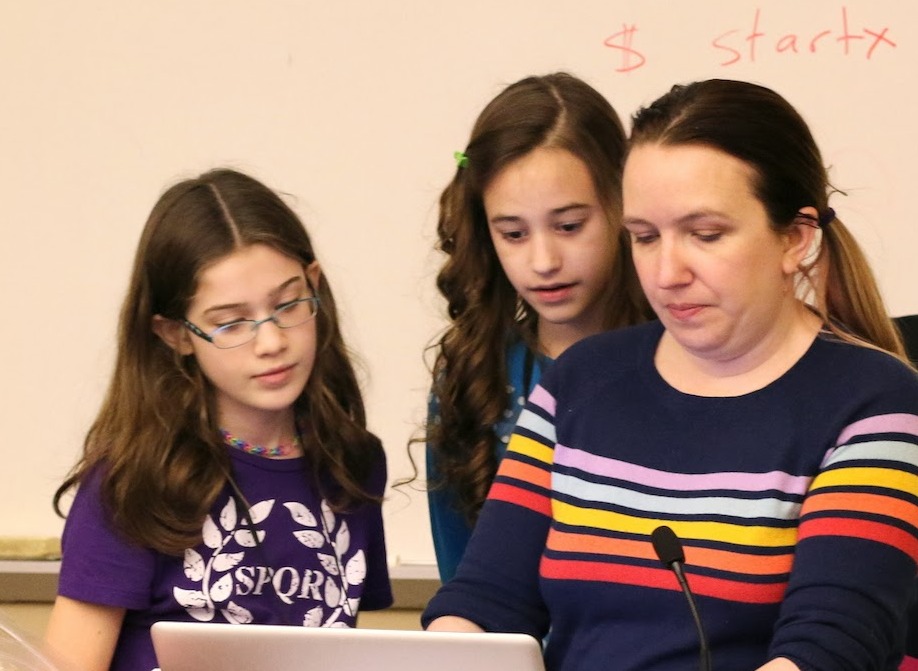
Imagine a room filled with pre-teens and teenagers eager to learn to code. Pretty daunting, huh? That’s the challenge Katie has taken on with Young Coders. This one-day tutorial covers basic Python by starting with simple concepts and then building up. Using Raspberry Pis, Katie says, helps to “demystify the computer,” and by the end of the day, students are doing fairly complex work with loops, and reading others' code. Last week at PyCon Montreal, 41 students attended one of the classes.

You can check out Katie and Barbara’s 2014 PyCon talk about Young Coders.


Katie teaching Young Coders


As we conversed about Python, teaching, and writing, I observed first-hand those qualities that make Katie an effective teacher—passion, clarity, perceptiveness, wit, and humor. With a degree in Psychology, she “stumbled into technology” and found that it paid well. “It’s hard to say ‘no’ to money when the alternative is to get an MA degree and make $40K,” she explained. But I believe that Katie is a natural teacher, so I’m not surprised that once in tech—she’s worked for NASA and Cox Media—she pioneered ways of making it more accessible to others and easier to learn. Her current professional position combines her technological prowess and her pedagogical talents as Senior Applications Developer and Director of Technology at Speak Agent, a provider of customized interactive content for language teachers. 


Some of Katie’s teaching philosophy and techniques come from her experience as a mother. She told me that her kids had access to their own computers at the age of three, in large part because she wanted them to stay away from her computer. The result is that her kids are very fluent—if you give them a computer, they can figure out immediately what to do with it. It’s not, according to Katie, that her seven year old daughter is so smart; rather she’s had four years of informal training. But of course many kids don’t have that advantage—they’ve grown up in homes where there was no computer, or maybe only one, but it was too precious to allow the kids to use it. Katie wants to be able to formalize the informal training—to teach kids such basic ideas as how to generally find something on the computer, or the differences between an email application, a web browser, and the internet (some kids, and even adults, confuse them). 


So Katie finds that using concrete metaphors and teaching basic vocabulary are extremely important in getting kids to understand coding. For example, Katie teaches the logic of and/or by reference to pet stores; in Virginia, in order to buy a fish, a person needs to be at least 18 years old, AND have money to pay for it, AND promise to put it in an aquarium and not into the river (apparently, this was a problem)—all of these conditions must be true. But when paying, you can use cash OR credit OR a data card OR a gift card. She says that her students respond well to these kinds of examples. Teaching this way is not only effective, but it “brings the humanity back into tech”—it shows that these are things that humans do, rather than abstract relations between a person and a machine. 


In the future, Katie would like to teach coding to younger children. Since the Young Coders track is restricted to ages 12 and older, Katie sees this as a real need. We have younger kids coming to PyCon, as more attendees bring their kids and want a class for them. But putting very young kids in a class with older learners doesn’t work well. Their needs and learning styles are quite different. For example, five year olds don’t have the physical control or dexterity to type or to sit still for long. Katie would like to develop a teaching track that is “more kinetic.” Basic concepts, like the logic of if/elif/else could be taught by having the kids get in one line IF their shirt is red, ELSE IF green, get in another; or ELSE, yet another.


I’m happy to report that these and other great ideas are going to be available in Katie’s next book, Kids Code (current working title). It will be an O'Reilly interactive book that has a dual purpose: 


[It] … not only teaches the student how to program, but teaches the mentor how to teach. Through carefully laid and interactive chapters, the student is guided not only through the basics of programming, but all the way up to game development and creating websites. At the same time, the mentor is coached in how to help their student solve problems, warned about where students often have trouble, and explains why lessons are structured in a certain way” (see LinkedIn).


The book sounds like a wonderful tool for teachers and learners (of all ages) and I’m looking forward to reading it. Thank you Katie, for sharing your expertise and insight with the rest of us. Your work is a huge part of what makes the Python community a living, growing, exciting, and powerful entity of awesomeness.


I would love to hear from readers. Please send feedback, comments, or blog ideas to me at msushi@gnosis.cx.


Popular Posts

Magix Vegas Pro 17.0.0.452 Free Download Magix Vegas Pro 17.0.0.452 Free Download includes all the necessary files to run perfectly on your ...